

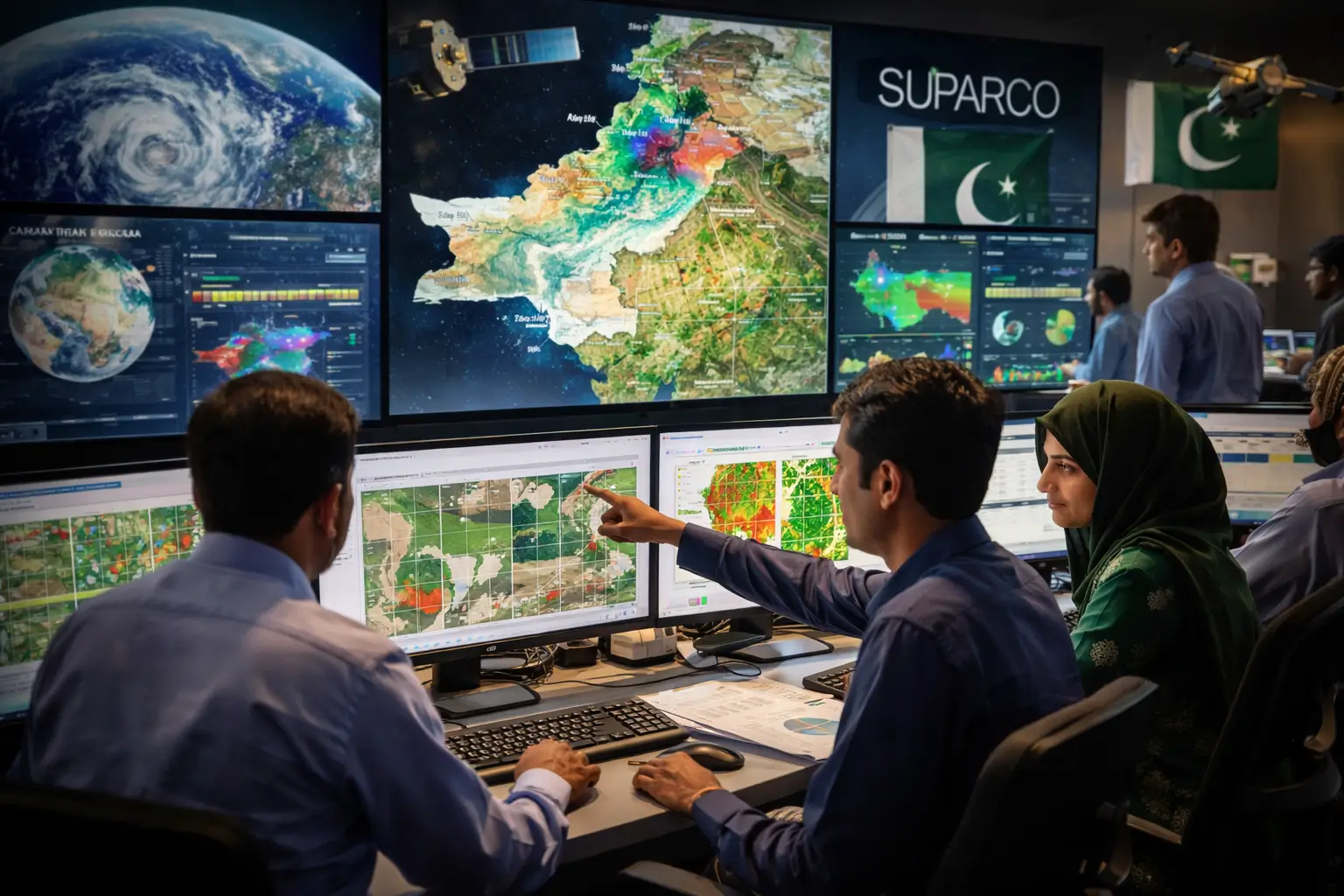
Pakistan’s national space agency, SUPARCO, has upgraded its satellite monitoring and remote sensing capabilities in 2026, marking a significant step toward strengthening climate observation, agricultural forecasting, and disaster preparedness frameworks across the country.
The development reflects a broader strategic shift toward data-driven governance and indigenous technological capacity building.
Strategic Context: Why Satellite Monitoring Matters
Pakistan faces recurring environmental and climate-related challenges, including:
- Flood cycles
- Glacial melt in northern regions
- Water stress
- Urban expansion pressures
- Agricultural yield volatility
Satellite-based remote sensing systems allow real-time monitoring of land, water, and atmospheric conditions — providing policymakers with actionable intelligence for long-term planning.
Experts note that strengthening domestic satellite capabilities reduces reliance on foreign data providers and enhances national technological autonomy.
Key Areas of Capability Enhancement
Agricultural Monitoring & Crop Forecasting
Upgraded remote sensing systems now provide improved precision in:
- Crop health assessment
- Yield prediction modeling
- Soil moisture tracking
- Irrigation pattern analysis
Agricultural planners can use this data to forecast production levels, optimize water distribution, and mitigate food supply risks.
This is particularly critical for provinces with high agricultural output such as Punjab and Sindh.
Flood Risk Mapping & Disaster Preparedness
Pakistan’s flood vulnerability requires proactive monitoring systems. Enhanced satellite data allows:
- River basin monitoring
- Rainfall accumulation tracking
- Early flood zone identification
- Evacuation planning support
Integration of satellite data into provincial disaster management authorities strengthens early warning mechanisms and resource deployment strategies.
Glacier & Climate Observation
Northern mountainous regions require continuous monitoring due to glacial melt and temperature shifts.
Advanced imaging capabilities improve:
- Glacier movement tracking
- Snow cover analysis
- Climate pattern modeling
- Watershed management planning
Environmental researchers highlight that long-term climate data archives are essential for adaptation policy design.
Urban Planning & Infrastructure Oversight
Satellite-based Geographic Information Systems (GIS) assist urban planners in:
- Monitoring population expansion
- Mapping illegal land encroachments
- Tracking infrastructure development
- Planning sustainable housing projects
Major metropolitan regions including Karachi and Islamabad can benefit from data-backed spatial planning.
Technological & Scientific Significance
The capability enhancement signals institutional strengthening within Pakistan’s space science ecosystem.
Analysts suggest that expanded remote sensing infrastructure:
- Enhances academic research capacity
- Supports environmental policy formulation
- Enables cross-ministerial data integration
- Strengthens international scientific collaboration
Indigenous technological development is viewed as a long-term investment in national resilience.
Economic & Strategic Impact
Improved satellite monitoring may also:
- Reduce disaster recovery costs
- Optimize agricultural supply chains
- Improve water resource allocation
- Enhance infrastructure planning efficiency
Over time, advanced remote sensing capabilities could support commercial geospatial services and technology exports.
Challenges & Future Outlook
Despite progress, sustained advancement requires:
- Continued budgetary allocation
- Skilled technical workforce development
- Upgraded ground station infrastructure
- Data security safeguards
Experts emphasize that long-term success depends on consistent investment and integration of satellite intelligence into policymaking processes.
Conclusion
The 2026 enhancement of satellite monitoring systems by SUPARCO represents a strategic advancement in Pakistan’s scientific and environmental governance capacity.
By strengthening climate tracking, agricultural forecasting, and disaster response mechanisms, the initiative positions Pakistan toward more data-driven national planning and technological self-reliance.
