

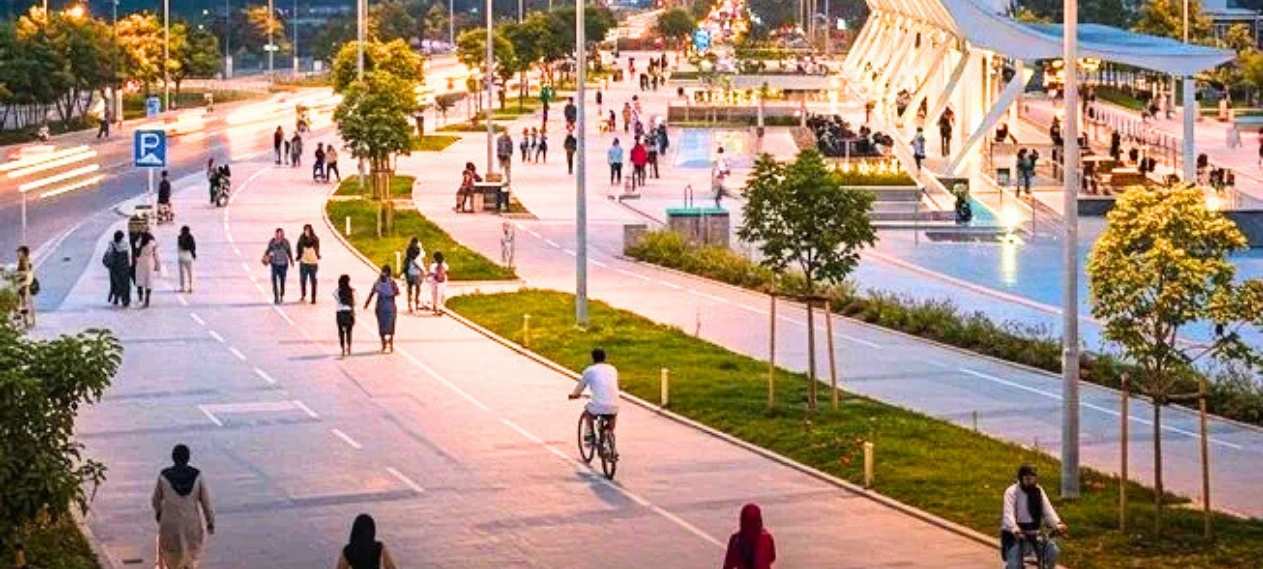
The Capital Development Authority (CDA) has announced plans to introduce electric carts and valet parking services at the newly developed Blue Area Food Street in Islamabad, aiming to improve accessibility and traffic management in the busy commercial district.
According to CDA officials, four electric carts will operate within the pedestrian-only food street, providing convenience for elderly citizens, children, and families. Additionally, a valet parking service will be launched along Jinnah Avenue to streamline vehicle parking and reduce traffic congestion in the surrounding areas.
These initiatives are part of a Rs. 240 million redevelopment project designed to transform Blue Area into a car-free, pedestrian-friendly zone. The project covers an 800-foot stretch of Jinnah Avenue, which is being converted into a public space prioritising walking, dining, and recreational activities, with regular vehicular movement restricted.
Officials stated that the project aims to enhance Islamabad’s urban experience by offering family-oriented dining areas, walkways, and digital entertainment facilities. The Blue Area Food Street is being developed on the model of Istanbul’s Istiklal Street and Lahore’s Nizami Street, combining modern urban planning with cultural and culinary attractions.
The food street will feature 18 to 20 specially designed kiosks offering a variety of local food items. To address parking requirements, a new parking plaza with capacity for approximately 1,000 vehicles has already been completed and is expected to open soon. Additional parking facilities are also being planned along Fazal-e-Haq Road for traders and visitors.
CDA officials further revealed that a third-party operator will be hired to manage the food street under the authority’s supervision. The operator will be responsible for operating electric carts and valet services, conducting stall auctions, submitting a lump-sum bid, and ensuring the provision of required facilities. The authority added that coordination with business owners is ongoing to minimise disruption during construction and once the food street becomes operational.
